Author Archives: admin

Slay the Egyptian

Moses was the greatest leader of our history, and arguably the greatest leader of any people’s history. But he had a very unusual backstory: He was raised not amongst his Jewish brethren, but in the king’s palace as the adopted son of Pharaoh’s daughter, reared on the lap of one of our people’s most heinous enemies. How did Moses become the leader and savior of the Jewish people despite being raised in a completely Egyptian environment? More specifically, what was the pivotal moment that made Moses the person he became?

Here’s my speculation.

The very first episode that the Torah relates to us about Moses is that he went out and saw the suffering of his brethren and he saw an Egyptian man striking a Hebrew man. The verse (Ex. 2:12) describes how Moses reacted: “he turned to and fro and saw that there was no man and he struck the Egyptian and buried him in the sand.” On a simple level this means that Moses killed the Egyptian man who was perpetrating a crime against the defenseless Hebrew slave after ascertaining that there were no witnesses to the crime.

Many years ago I heard a novel interpretation of this verse:

Moses was a conflicted man. His pedigree was Jewish, he was, after all, the grandson of Levi and the great-grandson of Jacob. But his upbringing was entirely Egyptian. Moses had dual identities. He was half Hebrew and half Egyptian and he straddled these two worlds.

The first thing the Torah tells us about Moses is the time where he has to choose between these two identities: He turned to the right and he turned to the left, he looked at his Jewish identity and he looked at his Egyptian identity, and he saw that there is no man. You cannot be both an Egyptian and a Hebrew. You cannot have your cake and eat it too. You must make a choice.

What did Moses do? He struck the Egyptian and buried him in the sand. He slayed his internal Egyptian identity and buried it in the sand. And he paid a heavy price: He had to face trial, he had to flee, and he forfeited the trappings of luxury and power as a prince in Pharaoh’s court. Moses made a choice. He chose to forever be a Hebrew come what may. He vacillated no longer.

There are many aspects of Moses’s storyline that can be informative and relevant to us. But this first episode of Moses’s life, this pivotal inflection point where he had to make a choice which identity to embrace, is something that all of us must make.

We all live at the crossroads of our existing self and our idealized self. Each one of us knows how great we can become; how powerful our latent abilities are, and how vast our potential is. That idealized self is something that we theoretically want and really hope we could get one day.

Moses shows us how to actually get it. You look to and fro, you look at your dual conflicting identities and you make a choice. It’s only if we seize our destiny and make that tough choice that we can unlock our greatness. Wanting it is wonderful but wanting something will not actualize it. You have to choose which version of yourself you want and then you slay the Egyptian, bury it in the sand, and forget about it forever.

With that choice Moses began a trajectory that led him to the top of Mount Sinai and to the greatest heights ever reached by a man. If we want to access our own Sinai and achieve our own potential we must make the choice.

Shemos – Grooming Greatness

Moses is the greatest leader of our history and the archetype of a great, transformative leader. Why was he chosen for the role? What was his training to become the leader he became? What are the Torah’s guidelines for leaders and people of influence. In this podcast we examine the Torah’s retelling of the protracted dialogue between God and Moses. Moses is resisting accepting the mantle of leadership. He objects for a bevy of different reasons before he ultimately accedes to accepting the role. Each objection posed by Moses and each rebuttal offered by the Almighty contain the keys to becoming a great leader.

– – – – – – – – – – – – – – – – – – – – – –

This Parsha Podcast is sponsored by my friend Krzysztof Grudzień in honor of his wife Malina on the occasion of our recent marriage.

On behalf of the entire Parsha Podcast family we wish them a hearty congratulations on their marriage and wish them a life of happiness and great health and harmony and prosperity together!

– – – – – – – – – – – – – – – – – – – – – –

Please email me at rabbiwolbe@gmail.com with any questions or comments

TORCH Shabbat Light Switch Cover

Please visit our website torchweb.org to get your FREE TORCH Shabbat Light Switch Cover.

or CLICK this LINK to access the form directly

https://docs.google.com/forms/d/e/1FAIpQLSd6A90DO9YIzUXxlHH3EEy5dz_H5mlch-N3GZdqtG9saMlYsA/viewform

SUBSCRIBE to my Newsletter

rabbiwolbe.com/newsletter

– – – – – – – – – – – – – – – – – – – – – –

Sponsorship: Please consider sponsoring a podcast by making a donation to help fund our Jewish outreach and educational efforts at https://www.torchweb.org/support.php. Thank you!

SUBSCRIBE to Rabbi Yaakov Wolbe’s Podcasts

The Parsha Podcast

The Jewish History Podcast

The Mitzvah Podcast 

This Jewish Life

The Ethics Podcast

TORAH 101

Start 2021 Right with The Parsha Podcast

One of my New Year’s resolutions is to record more episodes of The Jewish History Podcast in 2021. If you may indulge me, I would like to suggest to the audience to sample my Parsha Podcast in 2021. In this episode which covers Parshas Shemos, you can take it for a test drive to see if you want to consider subscribing and listening to it. Hope you enjoy and here’s to a fabulous 2021!

SUBSCRIBE to The Parsha Podcast with Rabbi Yaakov Wolbe

Apple Podcasts: https://itunes.apple.com/us/podcast/parsha-podcast-by-rabbi-yaakov/id1163966747

Spotify: https://open.spotify.com/show/7mZVqFjHNqUDD4k0Y4O3se

Google Podcasts: https://podcasts.google.com/?feed=aHR0cHM6Ly9yYWJiaXdvbGJlLmNvbS9mZWVkL3BhcnNoYS8

2020: A Year in TORCH Podcasts

I view the generous people who support our work at TORCH as our partners and investors in our spiritual enterprise. In this final email newsletter of 2020, I want to present you with your Investor Report so you know that your charity investment dollars are being well spent.

If you have yet to join the world’s most lucrative spiritual investment club, think of this email as a prospectus. To update your investor status, visit https://www.torchweb.org/support.php

This email will focus exclusively on my podcasts, and the reader is encouraged to visit our website to see all the other amazing projects that TORCH does.

At a Glance

Over the course of 2020 I have been fortunate to have released 162 podcast episodes across six podcast channels (The Parsha PodcastThe Jewish History PodcastTORAH 101This Jewish LifeThe Ethics PodcastThe Mitzvah Podcast).

With the help of the Almighty, the response from the audience has been incredible. Several of the shows have perennially ranked on the top ten on iTunes in the category of Judaism, and the download numbers have seen consistent growth.

And the numbers are truly staggering.

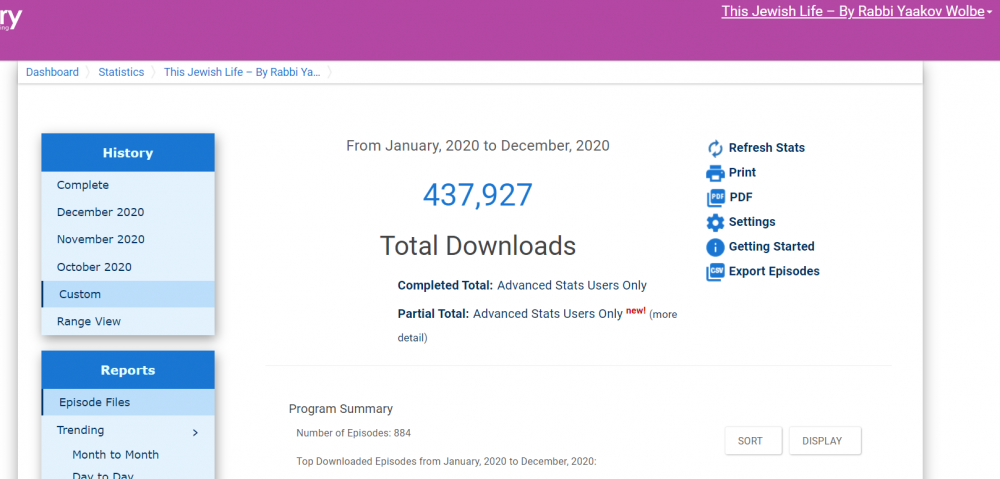
In the 12 months from January 1, 2020, until December 30, 2020, the podcasts have been downloaded 437,927 times, a more than 60% increase over the 273,280 downloads in 2019.
In addition, in 2020 the podcasts have been added to Spotify and have accumulated 45,387 “starts” (the metric that Spotify tracks) on that platform. It should be noted that “starts” on Spotify are not aggregated as server-side downloads, but downloads and streams from all other podcast apps (Apple Podcasts, Google podcasts, etc.) are included.

This is a long way of saying that the people who have supported TORCH on this initiative have partnered with us in spreading Torah and Jewish knowledge on a scale never before seen in history.

Impact of the Pandemic

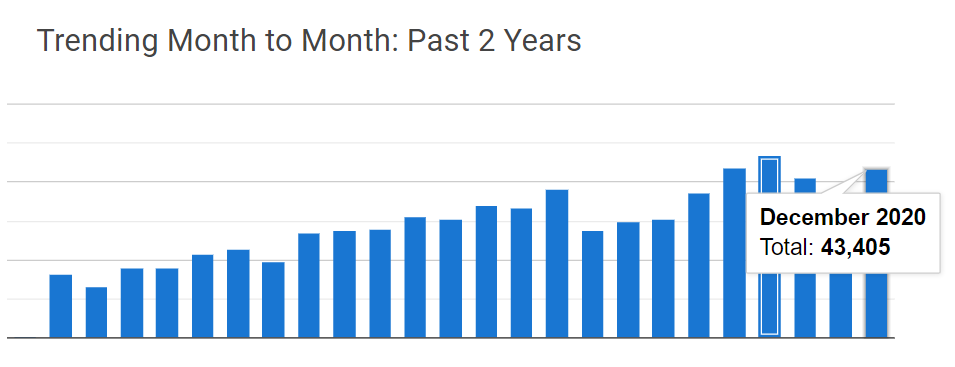
The pandemic had a mixed effect on our podcasting efforts. In the immediate months following the pandemic our numbers dipped (see the graph below) as people’s commutes and routines were disrupted. But as people began to adjust to the new realities the growth that we have experienced over the past couple of years resumed.
The full impact of the pandemic on the world of Jewish outreach, education, and learning is still unknown. Many believe that when the pandemic ends everything will go back to the way they always were.

I disagree. In my opinion, the impact of the pandemic on our industry will be far-reaching and permanent as the epicenter of Jewish education and outreach transitions from brick-and-mortar to digital. This transition was already afoot and the pandemic accelerated and amplified it.

Thankfully, TORCH is well positioned to be at the vanguard of the new world of Jewish outreach and education thanks to our expertise in creating unique digital products in this space and to our robust catalog of evergreen content (more than 1,000 podcast episodes and 1,000 YouTube videos).

Many of the people in the Jewish education and outreach space decry the proliferation of smartphones and Internet devices, saying that it shortens people’s attention span and makes them focus on more ephemeral pursuits in lieu of immersion in Torah and the wisdom of our glorious heritage.

Of course there is legitimacy to that claim, but history teaches us that every curse is accompanied with opportunity. What we can accomplish today thanks to the internet and smartphones exceeds anything we could have possibly done in Jewish outreach and education in a brick and mortar world. Instead of shunning technology, at TORCH we seek to harness it to its fullest extent. Our success in podcasting is a reflection of this perspective. If you want to partner with us on this mission we’d love to have your support.

Highlights of 2020

Beyond the big picture, I want to share some of the highlights of this past year in podcasting and some of my favorite episodes.

A&Q

When we began the fifth year of The Parsha Podcast after Simchat Torah, we launched a new segment called A&Q: at the end of every episode I present the audience with a question on the parsha for them to mull over and if they like, email me responses. The best answers are revealed in the following week’s episode. We are now 12 weeks into the new cycle and the audience has responded very enthusiastically.

Moreover it is a step in the direction that we hope to take the entire ecosystem towards. Podcasts are consumed passively. With A&Q, the audience is encouraged to become active: to think about the questions on their own, to discuss it around the Shabbat table, and to submit answers. Activating the audience is something that we’re thinking about a lot at TORCH and we hope to continue moving in that direction.

The Shabbat Gift

In August, I released an episode on the This Jewish Life Podcast titled, “The Shabbat Gift”. This episode has an interesting backstory: In the previous Yom Kippur I made, as is customary, a resolution to God in order to lobby Him to give me a favorable judgment. At the conclusion of the Neilah services I promised God to record a podcast over the course of the upcoming Jewish calendar year where I would share with the audience the transformative power and meaning of Shabbat. I had optimistically assumed that by Chanukah it would be done. But Chanukah came and went, and Purim came and went and I had not yet produced this episode. Then the pandemic hit and my children were home from school and everyone’s lives were upended. During our family’s annual drive back from Canada at the end of the summer I resolved to fulfill my pledge pronto, and in August, barely a month before the end of the Jewish year, I finally recorded and released this episode. I’m very happy with how it came out, and I hope the Almighty believes that I kept my part if the deal.

Pandemic Podcasts

When the pandemic hit, everyone was scrambling to deal with this new terrifying virus. In three episodes (thisthis, and that) I shared what I thought was a Torah perspective on the pandemic. Afterwards I felt that there was so much discussion about COVID in the news and it was dominating people’s lives so completely that it would be more helpful for me to make the podcast a refuge from all the COVID stuff, and therefore I stopped making it a focus of the podcasts.

Other Noteworthy Podcasts of 2020

I am very proud of all the episodes of 2020, but here are a few that I am particularly fond of:

Thanks a Million – When my podcasts cumulatively reached a million downloads, I recorded a special episode in which I told some of my personal story and outlined the surprising twists and turns in the journey to accomplishing this feat.

600,000 Letters of the Torah – Our Sages tell us that the Torah contains 600k letters, matching the number of Jewish souls. There is only one problem: It doesn’t. In this podcast I proposed a novel reconciliation that results in the total vindication of our Sages.

Age of the Universe: Reconciling Torah and Science – Science reports that the universe is ~13.8-15.4 billion years old. Our tradition teaches that we are in the year 5781. That is more than a slight rounding error. In this podcast I shared a mind-blowing answer.

A Grandson Remembers – Longtime podcast listeners know how much I revere my late grandfather, Rabbi Shlomo Wolbe zt”l. In this episode I share personal stories and reflections about the life and legacy of my grandfather.

Esau’s Fatal Flaw – Choosing which Parsha Podcast episode to appear on this list is hard because I am so fond of all of them. But this one is unique because it was conceived in a miraculous fashion. It was the night before I needed to record a new podcast on Parshas Toldos and I had nothing to say. I had read the Parsha and tried to gain an insight but I had nothing. I sat down by my desk at 11 PM and I started thinking about the Parsha. Within 20 minutes I had a complete podcast. What was so strange about it was that I felt like the Almighty deposited an entire podcast with a novel insight and a valuable lesson into my head like manna from Heaven. It popped into my head, fully formed, and ready for prime time. My takeaway from this story is that the Almighty is pleased with our work at TORCH and every once in a while He will wink at us and remind us that He’s got our back.

Chazon IshR’ Avraham Grozinsky, and Chacham Ovadia – On the Jewish History Podcast, I spent much of the year telling the stories of Torah giants of the 20th Century. Listening to the stories of these veritable giants inspires us to seek greatness ourselves.

A History of Oral Torah – The Jewish bookshelf is bursting with volumes ostensibly from the “Oral” Torah. In a series of episodes on the TORAH 101 Podcast channel, I traced the history of Oral Torah from Moses to Modernity. This series shatters the fiction of “Rabbinic Judaism”.

Akiva and Yehoshua Wolbe interview – This is a podcast that I did not record, but one that appears on my colleague Dan Kullman, President of the Board of TORCH’s, excellent podcast, The Shema Podcast. He interviewed my two oldest sons, Akiva and Yehoshua, about what it’s like to be a young boy in a Jewish community. It’s fair to say that if I have any podcasting ability, it was transmitted to my sons.

The Bottom Line

Our organization, TORCH, subsists solely thanks to the generosity of our friends and donors – our partners and investors. When you invest in TORCH, you can be confident that you will be partnering with an organization that is working tirelessly to produce the highest quality Torah education to the Jewish masses.

In 2020, 192 different people whose connection with TORCH was created over podcasts chose to donate to support the cause. These are the people who were personally impacted by our organization and chose to partner with us. Were you impacted by TORCH? Do you want to invest in our organization? If yes, please visit https://www.torchweb.org/support.php.

Vayechi – The Five Stages of Transformation

The Book of Genesis is replete with interesting stories. We follow the narrative about Adam and Noah and their families, Abraham and his odyssey and trials, Isaac and his family’s challenges and triumphs, and of course Jacob and Joseph and their stories capture our imagination and curiosity. “Torah” means instruction. As part of the Torah, Genesis must be instructive. Where are the instructions of Genesis? Stories are great, but what are the lessons? In the final Parsha Podcast of 2020 we suggest several answers to this important question.

– – – – – – – – – – – – – – – – – – – – – –

This Parsha Podcast is sponsored by Eli and Temima Lebowicz in loving memory of Eli’s mother Nancy Lebowicz, Chana Rochel bas Azriel Zelig, whose yartzeit falls out this week. May her soul be elevated in Heaven

– – – – – – – – – – – – – – – – – – – – – –

Please email me at rabbiwolbe@gmail.com with any questions or comments

TORCH Shabbat Light Switch Cover

Please visit our website torchweb.org to get your FREE TORCH Shabbat Light Switch Cover.

or CLICK this LINK to access the form directly

https://docs.google.com/forms/d/e/1FAIpQLSd6A90DO9YIzUXxlHH3EEy5dz_H5mlch-N3GZdqtG9saMlYsA/viewform

SUBSCRIBE to my Newsletter

rabbiwolbe.com/newsletter

– – – – – – – – – – – – – – – – – – – – – –

Sponsorship: Please consider sponsoring a podcast by making a donation to help fund our Jewish outreach and educational efforts at https://www.torchweb.org/support.php. Thank you!

SUBSCRIBE to Rabbi Yaakov Wolbe’s Podcasts

The Parsha Podcast

The Jewish History Podcast

The Mitzvah Podcast 

This Jewish Life

The Ethics Podcast

TORAH 101

Reincarnation and Animal Sacrifices

This past week I was studying the parsha with a dear friend of mine and the conversation segued to talking about reincarnation, a subject that I don’t profess to be an expert in and avoid talking about on the podcast. The person I was studying with expressed incredulity and skepticism about the idea of reincarnation in general. Reincarnation sounds like such a spooky and strange subject that rational, free-thinking, intelligent people tend to view it with skepticism. Jewish sources maintain that reincarnation does exist. What is the best way to reconcile our justifiable skepticism surrounding this subject?

My solution is what I call the Demystify and Deconstruct Heuristic:

Suppose we accept the following principles:

  1. God exists and He is good
  2. We have free will
  3. The Afterlife exists

These principles are a lot less controversial than the question of reincarnation. I would imagine that most believers would accept these principles as true. I think it’s logical for someone who accepts these principles as true to also accept the notion of reincarnation. Here’s why: God gives us free will. We get to choose if we favor our body or our soul. The choice to prioritize the physical or the spiritual is in our hands. In the event that a person chose to neglect their spiritual life, after they pass and their soul is untethered from their body, their soul is incomplete. It’s mission has not been fulfilled. How would we imagine that God in His benevolence would treat such a person? Isn’t it logical to say that the Almighty will afford such a person a second chance? Would we really consider that God wouldn’t give a person another opportunity to accomplish their mission? Of course the Almighty believes in second chances! By deconstructing the subject, it becomes much easier to swallow.

This subject also benefits from a useful Russell Conjugation. “Reincarnation” sounds scary and spooky. “Second Chances” is warm and fuzzy and makes us smile.

Animal Sacrifices

Another Torah concept that becomes more palatable when reframed in this fashion is animal sacrifices. The Book of Leviticus is replete with descriptions of all different kinds of sacrifices that must be done on regular intervals in the Temple. We don’t have a Temple, but we pray every day for its restoration and the concomitant resumption of animal sacrifices. There is no subject that I have encountered as much incredulity as the question of animal sacrifices. “Rabbi, do you actually believe that the Temple is going to be rebuilt on Temple Mount in Jerusalem and we’re going to resume doing animal sacrifices?!” To modern sensibilities, animal sacrifice feels barbaric. It seems so foreign and distant from the world that we live in. Yet tradition tells us that the Messiah will come and the Temple will be rebuilt and once again we will offer animal sacrifices.

This subject as well can be helped via this process.

Animal sacrifice sounds barbaric but beef is what’s for dinner. Those of us who are part of the 94% of Americans who are not vegetarian are obviously comfortable with the concept of killing an animal and eating its flesh. What’s the difference between animal sacrifices and steak dinners? One is delicious and the other is delicious and a mitzvah. Instead of thinking about animal sacrifices as barbaric ceremonies, when we reframe it to be steak dinners with a mitzvah it becomes palatable and even desirable.

This is not to suggest that there aren’t deep spiritual and Kabbalistic secrets in sacrifices (or reincarnation for that matter), but for someone who struggles with the notion of these foreign concepts and mitzvos, a simple reframing goes a long way in making them more palatable.

Where else do you think such a heuristic is helpful?

Vayigash – Fruitful Famine

In Parshas Vayigash, the Joseph trilogy comes to a close. The saga that began when Joseph was 17 ends when Jacob is reunited with his favorite son, now viceroy of Egypt. In this special edition of the Parsha Podcast, we offer three interesting observations: On Yocheved’s border-crossing birth, on Jacob’s second bargain with Esau, and on why the years of famine were worth it.

– – – – – – – – – – – – – – – – – – – – – –

This Parsha Podcast is sponsored by Alan and Phyllis Kritz in honor of the son Julian on the occasion of beginning to work at Jones Day. On behalf of the entire PP family, we wish Julian a hearty Mazal Tov and warm Congratulations on your new job. May you have tremendous success in this endeavor

If you want to sponsor an episode of the Parsha Podcast or if you have any questions or comments, please email me at rabbiwolbe@gmail.com

– – – – – – – – – – – – – – – – – – – – – –

Please email me at rabbiwolbe@gmail.com with any questions or comments

TORCH Shabbat Light Switch Cover

Please visit our website torchweb.org to get your FREE TORCH Shabbat Light Switch Cover.

or CLICK this LINK to access the form directly

https://docs.google.com/forms/d/e/1FAIpQLSd6A90DO9YIzUXxlHH3EEy5dz_H5mlch-N3GZdqtG9saMlYsA/viewform

SUBSCRIBE to my Newsletter

rabbiwolbe.com/newsletter

– – – – – – – – – – – – – – – – – – – – – –

Sponsorship: Please consider sponsoring a podcast by making a donation to help fund our Jewish outreach and educational efforts at https://www.torchweb.org/support.php. Thank you!

SUBSCRIBE to Rabbi Yaakov Wolbe’s Podcasts

The Parsha Podcast

The Jewish History Podcast

The Mitzvah Podcast 

This Jewish Life

The Ethics Podcast

TORAH 101

Ep. 76: JC in Jewish Sources: Exploring the Censored Text

As we approach the end of December, I chose to experiment by doing something a bit different in examining the Jewish take on the Christian hero and on early Christianity. When we look at the Talmudic sources on the matter we find that our version of this story is radically different than the Christian one, and, quite unsurprisingly, the Christian censors forced the Jewish printers of the Talmud to omit these sections. But these sections were preserved and clandestinely perpetuated, and in this episode we they reveal is fascinating.

Sanhedrin 107b Talmud

Sanhedrin 107b

– – – – – – – – – – – – – – – – – – – – – –

This Jewish History Podcast is sponsored by my dear friend, Shully Lichtman, who dedicated it in the merit of continued health for all.

If you want to sponsor an episode of the Jewish History Podcast or if you have any questions or comments, please email me at rabbiwolbe@gmail.com

– – – – – – – – – – – – – – – – – – – – – –

Please email me at rabbiwolbe@gmail.com with any questions or comments

TORCH Shabbat Light Switch Cover

Please visit our website torchweb.org to get your FREE TORCH Shabbat Light Switch Cover.

or CLICK this LINK to access the form directly

https://docs.google.com/forms/d/e/1FAIpQLSd6A90DO9YIzUXxlHH3EEy5dz_H5mlch-N3GZdqtG9saMlYsA/viewform

SUBSCRIBE to my Newsletter

rabbiwolbe.com/newsletter

– – – – – – – – – – – – – – – – – – – – – –

Sponsorship: Please consider sponsoring a podcast by making a donation to help fund our Jewish outreach and educational efforts at https://www.torchweb.org/support.php. Thank you!

SUBSCRIBE to Rabbi Yaakov Wolbe’s Podcasts

The Parsha Podcast

The Jewish History Podcast

The Mitzvah Podcast 

This Jewish Life

The Ethics Podcast

TORAH 101

Recurring Dreams (Issue #5) 12/17/2020)

The Parsha begins with Joseph languishing in prison. It’s been 2 years since he correctly interpreted the dreams of his two cellmates, and the newly reinstated Royal butler forgot Joseph, and his situation was dire.

That all changed when Pharaoh had frightening dreams of 7 fat cows being consumed by 7 frail cows and 7 robust ears of grain being swallowed by 7 pitiful ones. These dreams caused Pharaoh to seek Joseph’s dream-interpretation services and when Joseph skillfully interpreted the dreams he was promoted to viceroy of Egypt.

The Ohr HaChaim makes a very precise and critical reading of the first verse. He notes that the verse does not say that after two years Pharaoh dreamt. Rather the verse indicates that for 2 years Pharaoh was dreaming. He explains that Pharaoh had the identical dreams each night for two years, which he promptly forgot upon awakening. And now, 2 years after the butler was reinstated, Pharaoh finally remembered the dreams and was desperate to seek an interpretation.

This seems like a very strange suggestion. If Pharaoh forgot the dreams each night anyhow, why was it necessary for him to have these recurring nightmares? If Joseph was destined to languish in prison for two more years it doesn’t make sense to subject Pharaoh to the dreams that were not needed. Why did Pharaoh dream about cows and grain each night for two years only to forget them upon awakening?

One of the Hasidic Masters suggested an answer that radically reshapes how we think about Divine intervention and Divine providence. The Midrash states that Joseph underwent a lapse in his reliance on God when he asked the Butler to bring his case before Pharaoh. A man of Joseph’s stature he should have relied on God totally and not sought the help of the Butler. As a result of his insufficient faith, Joseph was penalized with two more years of incarceration. After 2 years Joseph ceased to rely on the Butler helping him, and restored his complete reliance on God, and right away the Almighty sprung the plan into action and Pharaoh dreamt.

But what would have happened had Joseph restored his total reliance on God earlier? That is what the Ohr HaChaim is telling us: Every single night of those two years, Pharaoh had the precise dreams that would have resulted in Joseph’s freedom and ascent to monarchy. Everything was in place; everything was ready; all that was needed was for Joseph to get ready. And each night because Joseph was not quite there yet Pharaoh forgot the dreams. But once Joseph restored his total reliance on God, Pharaoh remembered his dreams, and that very same day Joseph received Pharaoh’s ring, was bedecked in the garments of royalty, had a triumphal cavalcade throughout the city, and became the king he was destined to become.

We know that we must earn our Divine intervention and providence, but we have it backwards. We assume that the Almighty is waiting for us to pray or to become spiritually worthy and then He will begin the process of giving us our salvation. Here we learn that it’s the other way around: everything is already in place. Everything is ready to go. The almighty is anticipating us to make the move, to submit the prayer, to spiritually earn the merit – and once we become worthy the Divine salvation was there, waiting for us.

The recently approved COVID vaccine is an example of this model. Under normal conditions, when an experimental drug is being tested the process follows a certain sequence: There are various rounds of experimentation and trials where the safety and the efficacy of the given drug is tested. Once the tests seem promising then it’s submitted for approval by various agencies, and after approval, production and distribution begin. With the vaccine currently being rolled out everything was done concurrently in order to speed up the timeline. Even before efficacy and safety were established, production and distribution plans were already underway. With God, it’s always Operation Warp Speed. The Divine intervention, the Divine salvation is already in place pending approval.

In 2015, then Uber CEO Travis Kalanick was interviewed on one of the late night shows about the company’s new business, Uber Eats. When asked to explain how it works, Kalanick explained how with other online delivery companies, the process is that you order, then they make the food, it’s put in a car and delivered it to you. Uber Eats is different: “We make the food, we put it in a car, and then you order it and we deliver it to you.” I don’t know if this is the way Uber Eats still works, but at the time they were trying to eliminate the most annoying part about ordering food – the wait. You’re hungry and you want food now and you don’t want to wait. With this system you wouldn’t need to wait. The food is ready, all you need to do is order and then it is delivered.

Uber Eats and the COVID vaccine are metaphors for this deep and wonderfully inspiring insight into how the Almighty intervenes and aids people. Just like Joseph, the Almighty has a plan for how each one of us can achieve our destiny and fulfill our purpose. He wants to give us salvation, He wants to answer our prayers, He wants to shower us with blessings and goodness, He wants us to accomplish the mission that we were sent here to do. He wants to help us, but we need to earn it. We need to become spiritually worthy of that Divine blessing. I find it deeply comforting and inspiring to know that our salvation is already extant; its all lined up and ready to go pending Divine approval. The vaccines are made and are ready to be shipped. The food is fresh and delicious and in the car ready to be delivered. Pharaoh has a standing dream of cows and grain being swallowed – everything is in place. We submit the order, we become worthy of the salvation, and it is promptly unlocked. Everything is ready to go. Are you?

Mikeitz – Talent Evaluation

Joseph is one of the most impressive figures in Jewish history. His accomplishments are vast: His holiness under spiritually treacherous conditions are legendary, his faith in God remained unwavering, he is the paragon of seeing God’s Handiwork in the bad deeds of others. His accomplishments extend beyond the spiritual: At the age of 30 he undertook perhaps the most ambitious project in history: Organizing and stockpiling enough food to feed the entire world for 7 years. How is that for a Five Year Plan? Its astonishing to think about what goes into that, and Joseph pulls it off flawlessly. Joseph is the epitome of a wunderkind. Yet his brothers are blind to Joseph’s talent. In this podcast we explore the question of how Joseph’s brothers failed to recognize his prodigious abilities.

This Parsha Podcast is sponsored by Joseph Daniel and Elijah Levi Hiller in loving memory and honor of Reyna Hiller, my beloved wife and best friend of blessed memory. May Hashem bless and keep you, and may you always know how deeply you are loved and missed. May Reyna’s Soul be elevated in Heaven, and We appreciate their sponsorship and friendship

– – – – – – – – – – – – – – – – – – – – – –

Please email me at rabbiwolbe@gmail.com with any questions or comments

TORCH Shabbat Light Switch Cover

Please visit our website torchweb.org to get your FREE TORCH Shabbat Light Switch Cover.

or CLICK this LINK to access the form directly

https://docs.google.com/forms/d/e/1FAIpQLSd6A90DO9YIzUXxlHH3EEy5dz_H5mlch-N3GZdqtG9saMlYsA/viewform

SUBSCRIBE to my Newsletter

rabbiwolbe.com/newsletter

– – – – – – – – – – – – – – – – – – – – – –

Sponsorship: Please consider sponsoring a podcast by making a donation to help fund our Jewish outreach and educational efforts at https://www.torchweb.org/support.php. Thank you!

SUBSCRIBE to Rabbi Yaakov Wolbe’s Podcasts

The Parsha Podcast

The Jewish History Podcast

The Mitzvah Podcast 

This Jewish Life

The Ethics Podcast

TORAH 101

Chanukah and Joseph

Every year, Chanukah falls out during the weeks in which we read about Joseph and his exploits in Egypt. Our Sages tell us that there is a deep connection between Joseph’s and the Maccabean heroism.  Many connections have been proposed, and in this podcast I suggest a new approach to understanding how Joseph precisely embodies the story, the lesson, and the transformation of Chanukah.

– – – – – – – – – – – – – – – – – – – – – –

Please email me at rabbiwolbe@gmail.com with any questions or comments

TORCH Shabbat Light Switch Cover

Please visit our website torchweb.org to get your FREE TORCH Shabbat Light Switch Cover.

or CLICK this LINK to access the form directly

https://docs.google.com/forms/d/e/1FAIpQLSd6A90DO9YIzUXxlHH3EEy5dz_H5mlch-N3GZdqtG9saMlYsA/viewform

SUBSCRIBE to my Newsletter

rabbiwolbe.com/newsletter

– – – – – – – – – – – – – – – – – – – – – –

Sponsorship: Please consider sponsoring a podcast by making a donation to help fund our Jewish outreach and educational efforts at https://www.torchweb.org/support.php. Thank you!

SUBSCRIBE to Rabbi Yaakov Wolbe’s Podcasts

The Parsha Podcast

The Jewish History Podcast

The Mitzvah Podcast 

This Jewish Life

The Ethics Podcast

TORAH 101

Kindling Chanukah Candles (Issue #4 – 12/10/2020)

During Chanukah last year, I was invited to give a lecture at Aish Toronto (we had gone to visit family in Canada during winter break).

The talk began with a comparison of the two mitzvos that relate to lighting candles: Each Friday afternoon, of course, we light the Shabbos candles, and during Chanukah, we light the Menorah and its candles for the duration of the Festival’s eight days.

Both of these mitzvos require us to light candles, but upon examination they appear to be radically different, almost opposite mitzvos. By my count, there are at least 6 differences between the Shabbos candles and the Chanukah candles:

  1. Utility: We are not allowed to benefit from the Chanukah lights (which is why a Shamash is added). By contrast, the whole purpose of the Shabbos candles is to benefit from them
  2. Nature: The mitzvah of the Chanukah candles is the kindling (if the candles get extinguished, you have already fulfilled your duty and don’t need to tend to it). Shabbos candles are not about the action, but about the result: having the light in the home
  3. Timing: Shabbos candles must be lit before darkness, by contrast, Chanukah candles can only be lit after darkness
  4. Positioning: The Chanukah candles must be facing outside for public exhibition; Shabbos candles are only meant for the people inside the house
  5. Variability: The Chanukah lights are dynamic: The Talmud teaches us that there are three levels of the mitzvah: at a minimum, one candle for everyone in the home. The righteous who seek mitzvos have one candle per person in the home. And the super-duper-uber committed successively add another candle each night, culminating in eight candles on the eighth and final night of Chanukah. The Shabbos candles don’t have these different levels.
  6. Primacy: Halacha teaches us that both mitzvos are so important that if you don’t have candles, you even need to knock on doors and beg to be able to acquire them. But regarding Chanukah candles the sources add that should you find no other way to acquire Chanukah candles, you must even sell your clothing to purchase them. The Shabbos candles do not make that requirement.

These two mitzvos are obviously very different.

I don’t want to spoil it for you but if you have the time to listen to the entire talk you will discover that the candles are representative of our Soul, which has a long and dramatic and even spine-tingling history. The essence of Chanukah is to take that candle that is submerged within us and to make it surface and shine forth brightly. Shabbat represents something very different.

If you don’t have the time to listen to it, I hope you find these differences intriguing and thought-provoking.

Question of the week

Since the beginning of the Jewish calendar year, the Parsha Podcast has featured a recurring segment at the end of each episode called A&Q. A&Q is the opposite of Q&A. Q&A is when the audience asks the presenter a question and the presenter offers a (hopefully satisfactory) answer. In A&Q the audience is presented with a question and they must supply the answer. At the end of each week’s episode, I provide a question on that week’s Parsha, and solicit answers from the audience.

The response to this segment has been off the charts!

Every week the incredible and indefatigable Parsha Podcast audience offer wonderful and diverse answers, many of which are featured in the following week’s episode.

My friend Paul suggested that I include the question of the week in the newsletter. I’m not promising to give any answers, but it’s a good thing to cogitate upon if you missed this week’s episode, and hopefully it will encourage non-listeners to join the Parsha Podcast community or at least to sample it.

So here it goes: Joseph undergoes many transformations in his narrative in the Torah, and all of them are initiated by dreams.

He has dreams of grandeur that amplify the enmity of his brothers. As a result of his seemingly megalomaniacal dreams, they hate him and want to kill him, ultimately settling for selling him as a slave.
In Egypt, Joseph is imprisoned, seemingly without any hope, and when he correctly interprets the dreams of two of Pharaoh’s aides his bona fides as a gifted dream interpreter are established.
In next week’s Parsha, Pharaoh has two bothersome dreams and when he is desperately seeking for an interpretation Joseph is ushered out of his incarceration. After he skillfully interprets the dreams, Pharaoh installs him as viceroy of Egypt.

it’s clearly not a coincidence that every transition in Joseph’s life is precipitated by a dream.

Moreover, the dreams come in pairs: he has two dreams that spark his brother’s hatred, the Butler and the Baker have a dream apiece, and Pharaoh has two dreams that spur him to find an explanation. Seemingly every step in Joseph’s development could have been effectuated by a single dream: He has one dream that causes the brothers to hate him; the Butler’s dream is correctly interpreted, and Pharaoh’s single dream is resolved by Joseph.

So here’s the question of the week: Why is every stage in Joseph’s progression caused by dreams, and why are the dreams all doubled? if you have any answers. email them to me rabbiwolbe@gmail.com