Podcast: Download (Duration: 25:15 — 11.6MB)
Subscribe: RSS
Abraham died when he was 175; Isaac – 180; Jacob – 147; Moses an even 120. How did they live that long? Is there a secret elixir of life that they consumed? What was their diet?
Podcast: Download (Duration: 1:24:44 — 38.8MB)
Subscribe: RSS
Judaism teaches that God controls, supervises, manipulates and directs Jewish History. While we struggle to understand why the unprecedented genocide of the Holocaust had to happen, we know that God willed it. Of course this raises important and grave questions, which must be examined thoughtfully and sensitively. This class is a recounting of a largely unknown but remarkable story of the renowned Mir Yeshiva ‘s miraculous escape from danger intact; it’s trans-Siberian journey to Japan and China and it’s reestablishment as a dynamic Torah center halfway across the world while European Jewry was being decimated. We follow the story lines of two protagonists, Rabbis Shlomo Wolbe and Aron Florans zt”l – mine and my wife’s paternal grandfathers respectively – and tell the story of how they participated in and contributed to God’s plan to resuscitate the Torah world from the ashes and despair of the fiery inferno that so brutally consumed it.
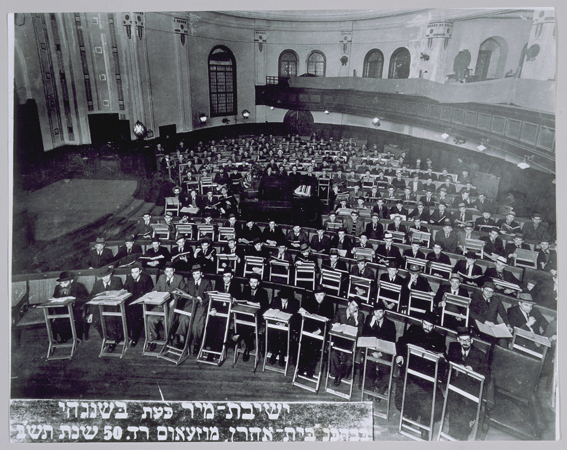 Mir Yeshiva Shanghai
The differences between chametz (leavened bread) that Jews are forbidden to eat on Passover and the matzah that Jews are required to eat on Passover are seemingly minute. In fact, chametz and matzah may have the exact same ingredients – flour and water – the only difference being that chametz bread was allowed to puff up and rise while the matzah is fastidiously flattened and swiftly baked to avoid any puffication. Seemingly a minor distinction indeed. Yet the prohibition of consuming chametz on Passover carries such enormous weight that a person who violates this commandment is spiritually cut off (kareis) from the Jewish people. This very strict punishment for what looks like a very small infraction begs the question: What is the meaning behind this enigmatic mitzvah and what is so fundamental about it that its transgression results in being disenfranchised from the Jewish nation? This is question number one.
We are all aware of the important role that the yetzer ra (evil inclination) plays in Jewish philosophy; namely to be the chief impediment in our paths to achieving what is required of us in our spiritual lives. The yetzer ra is the reason why we struggle to identify ourselves as spiritual beings, why mitzvahs sometimes seem to us a burden, and why we have a tendency to refrain from seeking spiritual successes and instead crave physical pleasures alone. This formidable foe is classified in the Talmud (Brachos 17a) as “the leaven in the bread.” This puzzling classification brings us to question number two: What does the force that is constantly compelling us to sin – our evil inclination – have to do with the culinary quality that makes bread rise; that transforms matzah to chametz?
Perhaps this Talmudic statement can shed some light on the root of the yetzer ra and illuminate our eyes to the path to overcome this great obstacle. The core conflict of our lives is the struggle between our bodies and souls, between the physical and spiritual. Are we going to prioritize our body, its whims and agenda, or will our soul be the sole goal of our existence, and our body merely the tool to actualize the soul’s desires? Will we view the physical as a means to accomplish our real goals which are our soulful eternal desires, or will we make the fatal error of forgetting that this world is a transient one, a mere corridor to a world where mitzvahs and spiritual accomplishments are all that matters, and get caught up with the trappings and glamour of this physical world? This equation of viewing our physical entities as a means or as an end is the challenge of existence and is symbolized by the difference between matzah and chametz. While it is true that everyone must take steps to ensure that their physical needs are met, the proper attitude must be that one can suffice with matzah, with the realization that their interactions with the physical world are only to provide fuel and energy to accomplish life’s true goals. The aim of the yetzer ra is to take the physical world and enlarge, expand, augment and aggrandize it – mirroring precisely the transformation from matzah to chametz – and attempt to deceive us into believing that this physical life is what we should strive for. On Passover when we chew on the minimalistic matzah – that unpretentious food devoid of any trappings of excess – we remind ourselves of this crucial lesson at the core of the Jewish Weltanschauung: to eschew the mistaken notion that this passing world and all of its physical distractions have any intrinsic value, rather to adopt the matzah view of life that physicality must take a back seat to the true aims of our existence: Torah, mitzvahs and other soulful activities. This is the lesson behind matzah and chametz, and this is why the Torah views this mitzvah so stringently, because it underscores the very essence of the Jewish mission.
Podcast: Download (Duration: 1:09:06 — 31.6MB)
Subscribe: RSS
The experience of pain and suffering is ubiquitous across all spectrum of human life. All of us, in some capacity, experience difficulties and challenges. Any measure of human suffering creates a dilemma for believers in a just God: How can a just God supervise over injustice? Why do bad things happen to good people? This problem has been the subject of much grappling in classical Jewish Literature for centuries. When examining and dissecting the various sources several interesting patterns emerge.
Sources discussed:
1. Menachos 29b: When Moses ascended to Heaven he found the Almighty sitting and tying crowns atop letters. Moses asked: Who is obstructing your way? God responded: There is a man who will be in the future after several generations and his name is Akiva Ben Yosef who will derive piles and piles of laws from every tick and Mark [of the letters] . [Moses] said “show him to me”. He said: Go back! He went and he sat at the end of eight rows and he did not know what they were saying and he became dejected. When Rabbi Akiva arrived at a certain matter, his students questioned from where do you know this law? He said to them “It is a Law to Moses from Sinai”, and Moses was placated. He returned and stood before the Almighty and said: “Master of the world, you a man such as this and you give the Torah via me?” He said: “Silence! So it was deemed in my mind.” [Moses] said: “Master of the world, you showed me his Torah now show me his reward.” He said: “Go back!” He went and he saw that they were flaying his skin with combs. He said [to God] “Master of the world, this is Torah and this is the reward?” God responded: “Silence! So it was deemed in my mind.”
2. Berachos 7a: And Rabbi Yochanan said in the name of Rabbi Yosi: Three things Moses asked from the Almighty and he gave him…He asked to know the ways of God and he gave him, as Scripture states (Exodus 33) “Inform me of your ways”, [Moses] said to God: “Why is there a righteous person and it is good for him; a righteous person and it is bad for him; a wicked person and it is good for him; a wicked person and it is bad for him?” So [God] responded: a righteous person and it is good for him – a completely righteous person; a righteous person and it is bad for him – a partially righteous person; a wicked person and it is good for him – a partially wicked person; a wicked person and it is bad for him – a completely wicked person.
3. Sanhedrin 101a: When Rabbi Eliezer was sick, his students came to visit him. Rabbi Eliezer said: “there is a great fury in the world”! The student began to cry and Rabbi Akiva laughed. They asked him why are you laughing? Rabbi Akiva: “Why are you crying”? They said to him: Is it possible that a Torah scroll is in pain and we will not cry”? He said to them “that is precisely why I am laughing. For all the time I saw our teacher’s wine not ferment, his flax not smitten and his oil not spoil I said perhaps God forbid our teacher received his reward in this world, and now that I see him in pain I am happy.
Podcast: Download (Duration: 1:53:49 — 52.1MB)
Subscribe: RSS
Striving for character development and ethical refinement are included in the demands that the Almighty expects from every Jew. The very first step on the path to total character perfection is acquiring and refining our capacity to have patience.
Podcast: Download (Duration: 1:55:37 — 52.9MB)
Subscribe: RSS
Ever since the founding of the Jewish state tension between the political and societal elements in Israel and the religious implications of a Jewish state have existed. In truth, the Zionist dream was hotly divisive across a very broad spectrum of the Jewish world fifty years before Israel’s founding. Recently several issues in the Israeli culture have propelled this debate to center stage again. A non exhaustive list: the compelling of Yeshiva students to join the army, government funding of Yeshivas, the status of Temple Mount, land for peace swaps. We will discuss some of the historical debates and positions regarding early Zionism, delve into the clashes and resolutions to this conflict that happened throughout the history of Israel, and try to explain the contemporary ongoing issues and various perspectives on these critical matters.